The True ROI of Robot Cleaners: It’s Not Just About Replacing Labor
For years, the sales pitch for autonomous mobile robots (AMRs)—specifically commercial robot floor scrubbers and vacuums—has centered on a single, crude metric: cutting headcount. The argument suggests that purchasing a robot allows a facility to immediately reduce staff numbers.
However, in the current economic climate, this perspective is shortsighted. The “replacement” model fails to account for the complexities of modern facility management.
In today’s tight labor market, the goal is rarely to fire reliable staff; it is to keep them. The true Return on Investment (ROI) of robotic floor cleaners extends far beyond a simple wage comparison. It involves calculating the hidden costs that silently bleed budgets: liability, inconsistency, and the relentless cycle of turnover.
For organizations considering automation, here is the comprehensive business case for robotic floor cleaners—moving beyond hourly wages to the strategic financial benefits that truly matter.
At a Glance: The 4 Pillars of Robot ROI
- Risk Mitigation: Drastically reducing Workers’ Compensation claims related to repetitive strain injuries and slip-and-falls.
- Consistency & Validation: Providing data-driven “proof of clean” that ensures standards never slip, protecting reputation and asset value.
- Ending the Turnover Cycle: Eliminating the high, hidden costs of constantly recruiting and training new staff for high-churn roles.
- Labor Optimization: Reallocating human staff from monotonous floor care to high-value, detailed sanitization tasks.
1. Reducing Liability and Workers’ Compensation Costs
One of the most overlooked financial arguments for automation is risk management. Manual floor cleaning is physically demanding work that carries significant injury risks.
Pushing heavy mop buckets or maneuvering manual walk-behind scrubbers for eight-hour shifts often leads to repetitive strain injuries (RSI), back issues, and shoulder fatigue. Furthermore, wet floors cleaned during staffed hours increase slip-and-fall risks for both the custodial team and building occupants.
According to the National Safety Council, a single slip-and-fall injury can cost an organization tens of thousands of dollars in medical expenses, lost productivity, and administrative processing.
The Robotic ROI:
Robots do not suffer from fatigue or repetitive strain. By automating the heaviest, most monotonous floor tasks, facilities remove human staff from the highest-risk activities. This shift doesn’t just improve safety culture; it directly impacts the bottom line by reducing the frequency of claims and potentially lowering long-term insurance premiums.
2. The Value of Consistency and Data Validation
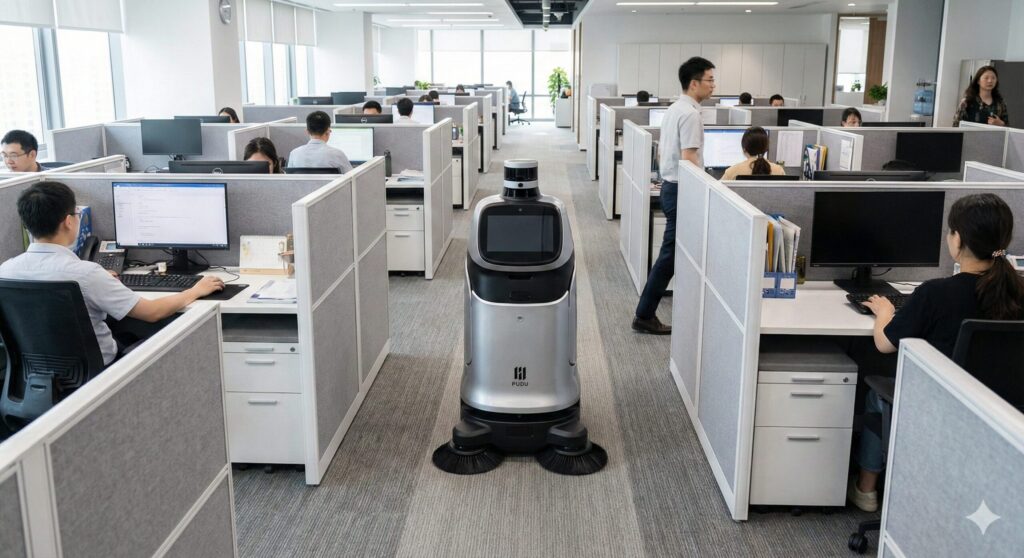
Human cleaning, by nature, varies. Fatigue, distractions, or tight schedules mean that a hallway cleaned at the end of a shift may not receive the same attention as one cleaned at the start. Inconsistent cleaning leads to tenant complaints, lower facility health scores, and a degradation of the building’s brand.
The Robotic ROI:
Autonomous robots offer absolute consistency. They follow a programmed route at a set speed with consistent brush pressure, regardless of the time of day.
More importantly, modern commercial robots provide data validation. Facility Managers receive detailed reports verifying exactly when and where cleaning occurred, complete with heat maps and water usage data. This “proof of clean” is a tangible asset. In an era of heightened hygiene awareness, the ability to digitally prove to stakeholders or auditors that a facility is sanitized to specification provides a level of quality assurance that manual logs cannot match.
3. Breaking the Expensive Cycle of Turnover
The commercial cleaning industry faces notoriously high turnover rates, often exceeding 200% annually. The administrative cost of this churn is massive.
Every time a cleaner quits, the organization spends money on advertising, interviewing, background checks, onboarding, and training—only to potentially repeat the cycle weeks later. This “hiring treadmill” is a significant operational expense that rarely appears on a standard P&L statement under “Cleaning Costs.”

The Robotic ROI:
Deploying a robot to handle large-scale vacuuming or scrubbing changes the nature of the custodial role. The job shifts from grueling physical labor to technology management.
By removing the most exhausting parts of the workload, employee morale improves, leading to higher retention. The financial gain here comes from avoided costs—specifically, the thousands of dollars saved annually by not having to constantly recruit and train replacements for high-churn positions.
4. Labor Optimization: Reallocation vs. Replacement
Finally, the wage argument requires reframing. While robots do save labor hours, the smartest organizations use those hours to optimize, not eliminate, their workforce.
If a robot takes over the three hours required to scrub a warehouse floor, the human staff member is not necessarily removed. Instead, that time is reallocated to high-value tasks that robots cannot perform: dusting high surfaces, sanitizing door handles and elevator buttons, detailed restroom cleaning, and waste management.
The Robotic ROI:
This approach yields a higher quality product—a cleaner, healthier building—for the same labor cost. It maximizes the value of every human hour paid for by focusing staff on tasks that require dexterity, judgment, and detail, while the robot handles the dull, repetitive ground work.
The Bottom Line
When presenting the case for commercial robot vacuums or scrubbers to financial stakeholders, the conversation should not be limited to “it cleans floors.” It is a discussion about business outcomes.
A strategic investment in automation stabilizes operational costs, reduces corporate liability exposure, provides audit-proof data on facility standards, and insulates the company from a volatile labor market. That is a complete picture of Return on Investment.