Is Your Facility Ready for a Robot Floor Cleaner? A 5-Point Checklist
Introduction: The Hype vs. The Hard Reality
The pressure to automate is relentless. For a CFO or Facility Manager facing historic labor shortages, the promise of a machine that shows up every day, never gets injured, and generates consistent data is seductive.
But aggressive sales brochures often gloss over a hard truth: Not every building is a candidate for robotics.
While the technology has matured, the physical reality of your facility dictates success. A robot is a tool, not a magician; it thrives in structured environments and fails in chaotic ones. Deploying a $40,000 autonomous scrubber into a facility that is physically hostile to robots is not an investment—it is an expensive paperweight.
Before you spend hours researching models or calculating theoretical ROI, you must perform a site assessment. Here is the 5-point operational reality check to determine if your facility is actually “Robot Ready.”
1. Do You Have Wide, Open Corridors? (The Clutter Factor)
The most immediate disqualifier for commercial robotics is density. Robots hate clutter.
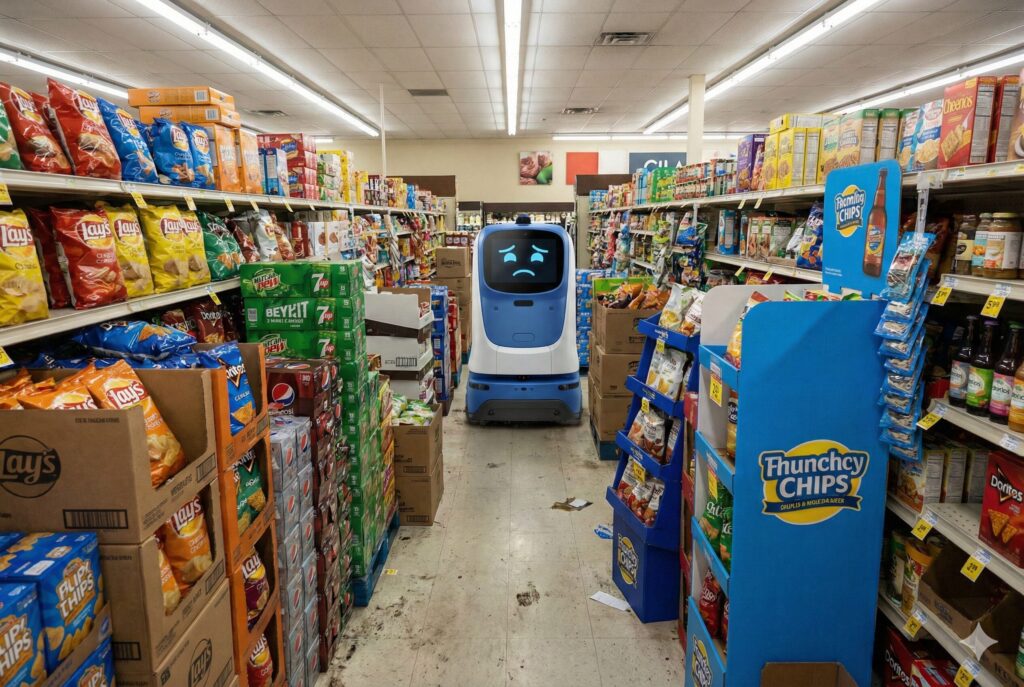
To understand why, consider “cleanable square footage.” When a robot maps a room, it draws a safety bubble around itself. If a corridor is 48 inches wide, but you have pallets sticking out on one side and temporary displays on the other, the “drivable” path vanishes.
The Metric to Watch:
Most commercial autonomous scrubbers require a specific minimum pass width.
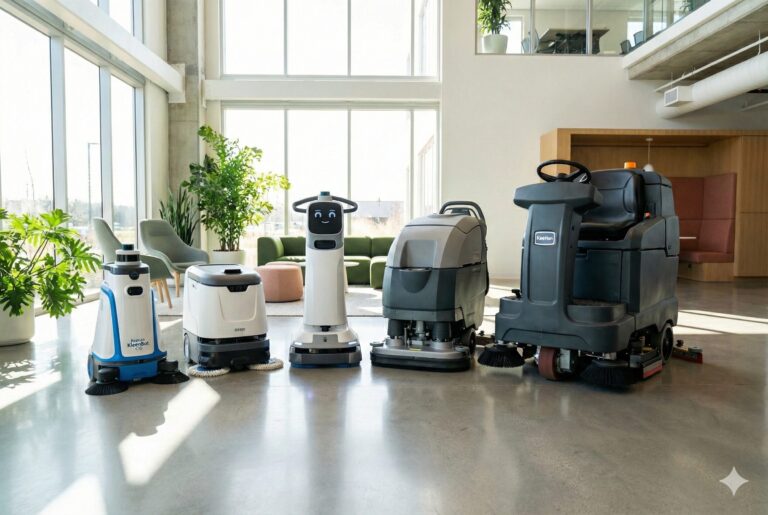
- Small units: Typically need 28–32 inches.
- Large industrial units: Often need 40–50 inches.
If your facility is a “maze”—narrow paths, loose cables, or high-density furniture—a robot will spend its battery life in a “blocked” state, constantly signaling for human help. If your staff has to rescue the robot every 10 minutes, you have increased labor costs, not decreased them.
The Rule: If you can’t drive a pallet jack through it easily, a robot probably can’t clean it.
2. Is Your Flooring Consistent? (The Terrain Test)
Humans adapt to changes in terrain instantly; robots do not. Commercial units excel on consistent flooring like terrazzo, polished concrete, or VCT. They struggle with transitions.
The Three Main Enemies:
- Threshold Plates: Metal transition strips higher than 0.5 inches act as walls to many sensors. The robot will either refuse to cross or bottom out and get stuck.
- Steep Inclines: While most units handle ADA-compliant ramps, steep grades drain batteries rapidly and can cause dirty water to spill from recovery tanks.
- High-Contrast Patterns: A known edge case involves black carpet or dark patterns. Downward-facing safety sensors often interpret black stripes as “cliffs” or holes in the floor, causing the robot to emergency brake on perfectly flat ground.
3. Do You Have a “Home Base”? (The Infrastructure Question)
You cannot simply unbox a robot and turn it on. It needs a dedicated “Home Base” for charging and maintenance.
The Requirements:
- Space: A designated parking spot (roughly the footprint of a pallet) that must be kept clear 24/7.
- Power: Standard outlets suffice for smaller units, but industrial machines may require dedicated circuits for rapid charging.
- Water & Drainage: This is the biggest logistical hurdle.
- Manual Docking: A human must wheel the robot to a utility sink to drain/refill.
- Autonomous Docking: High-end models can self-service, but this requires significant plumbing work to tap into water lines and floor drains at the docking site.
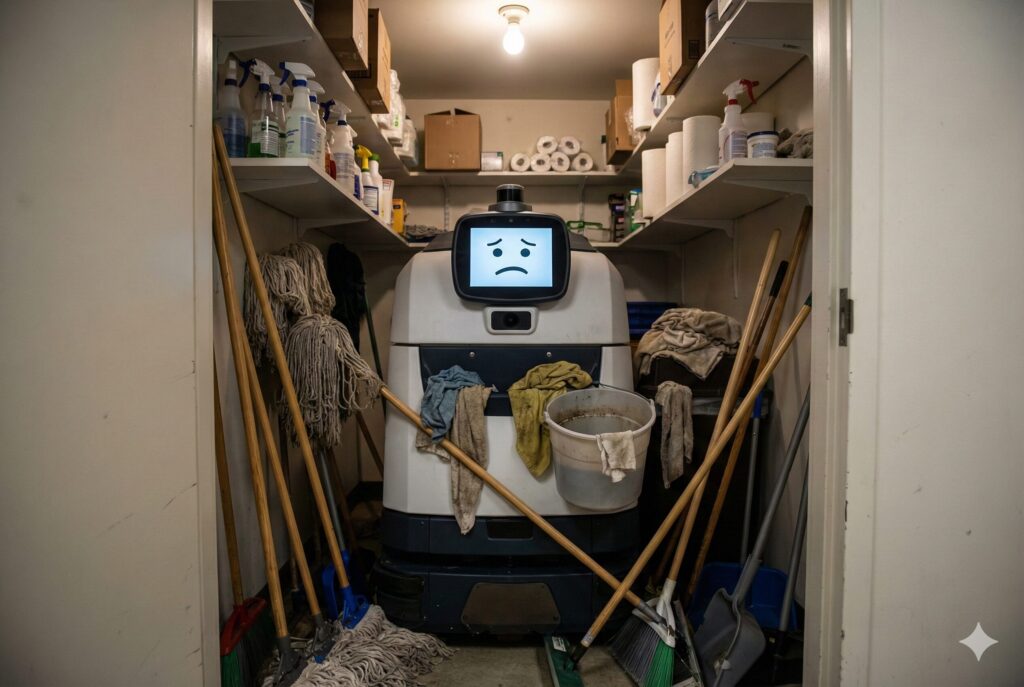
If your “Janitor’s Closet” is already overflowing with ladders and paper supplies, you need to identify where you’re going to set-up your new infrastructure before signing the PO.
4. Is Your Cleaning Schedule Repetitive? (The Consistency Check)
Robots are deterministic machines. They thrive on “Groundhog Day”—repeating the exact same task, the exact same way, every time.
This makes them ideal for the “Main Race Track”—the long loops in grocery stores, airport concourses, or warehouse aisles. These areas get dirty in a predictable way and require daily maintenance.
They are poor at reactive cleaning. If a child spills a drink or a pallet breaks, a human can spot-clean it in two minutes. A robot requires you to interrupt its cycle and manually drive it to the spill.
The 80/20 Strategy:
Automate the 80% of floor care that is boring and repetitive (hallways, lobbies). Keep humans on the 20% that requires judgment and dexterity (edges, restrooms, spills).
5. Is Your Staff Ready to Collaborate? (The Culture Check)
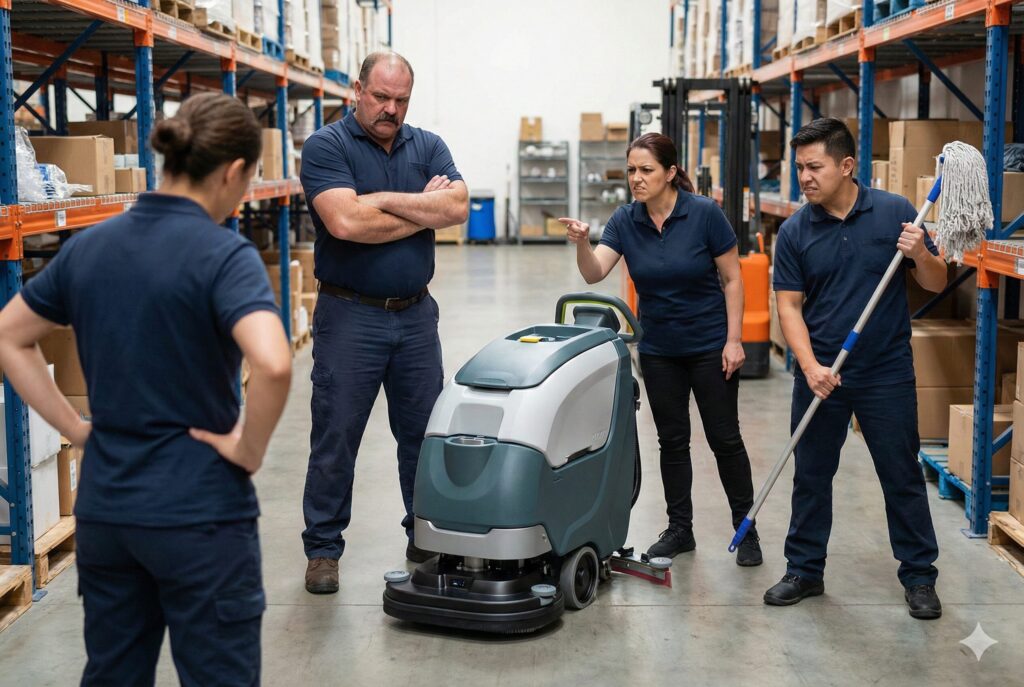
This is the most common point of failure. If your frontline staff believes the robot is there to replace them, they will ensure it fails. We have seen staff intentionally block routes, unplug chargers, or park machines in corners to prove they “don’t work.”
The “Cobot” Approach:
Successful deployments position the machine as a “Cobot” (Collaborative Robot). The message must be clear: “This machine pushes the heavy scrubber for 4 hours so you don’t have to. You are now free to focus on high-value tasks like detail work and disinfecting.”
When staff view the robot as a tool that reduces their fatigue, they take ownership of it. They name it. They protect it.
If they fear it, the deployment is doomed.
The Verdict: The Goldilocks Zone
If you have open halls, consistent floors, available infrastructure, and a repetitive cleaning scope, you are in the “Goldilocks Zone” for automation. In this environment, the ROI is undeniable, allowing you to reallocate labor and secure “proof of clean” data.
If your facility is a cramped maze with shag carpet and no water access, you just saved yourself a $40,000 mistake.
Next Steps:
New to Automation?
This article is Part 2 of our Start Here series.
← Read Part 1: Technology | Read Part 3: Selection →