Beyond the Roomba: How Commercial Cleaning Robots Actually Work
Introduction: The Evolution of Clean
If you are imagining a giant version of the little disc vacuum running around your living room bumping into table legs, think bigger. Much bigger.
For Facility Managers (FMs) and Chief Financial Officers (CFOs), the concept of automation often teeters between the promise of efficiency and the fear of complex implementation. However, the cleaning industry is currently undergoing a seismic shift, moving away from manual, labor-intensive processes toward data-driven, autonomous solutions.
Commercial cleaning robots—technically known as Autonomous Mobile Robots (AMRs)—are not merely gadgets; they are sophisticated industrial machines designed to navigate complex, dynamic environments like airports, hospitals, manufacturing plants, and sprawling warehouses without human intervention.
To understand the ROI and operational impact of these machines, one must first understand the technology that drives them. Unlike the “dumb” robots of the past—Automated Guided Vehicles (AGVs)—which required expensive infrastructure changes like magnetic tape or wires installed in the floor, modern AMRs “see” the world much the way self-driving cars do. They are not trains on a track; they are intelligent agents capable of making decisions.
This post will demystify the technology behind these machines, explaining how they navigate, how they are trained, and why they are safer than a manual floor scrubber.
The Great Leap: From AGVs to AMRs
For a CFO analyzing capital expenditure, the distinction between an AGV and an AMR is critical.
AGVs (Automated Guided Vehicles) have been around for decades. They follow a fixed path, usually defined by wires, magnetic strips, or sensors buried in the floor. If a pallet is left on the magnetic strip, the AGV stops and waits for a human to move it. They are efficient but inflexible. Installing them requires facility downtime and significant infrastructure investment.
AMRs (Autonomous Mobile Robots), conversely, require no facility modifications. They use onboard computers and sensors to map their environment. If they encounter an obstacle, they can navigate around it (depending on safety protocols) or recalculate a path. For the Facility Manager, this means flexibility. If the layout of the warehouse changes next quarter, you don’t need to rip up the floor; you simply re-map the robot.
How They “See”: The Battle of Navigation Technologies
The “secret sauce” of any commercial robot is its navigation stack. How does a machine know where it is within a 500,000-square-foot facility, down to the inch? Generally, commercial robots rely on one of two primary technologies (or a fusion of both): LiDAR and vSLAM.
Understanding the difference is vital when selecting a robot for your specific environment.
1. LiDAR (Light Detection and Ranging)
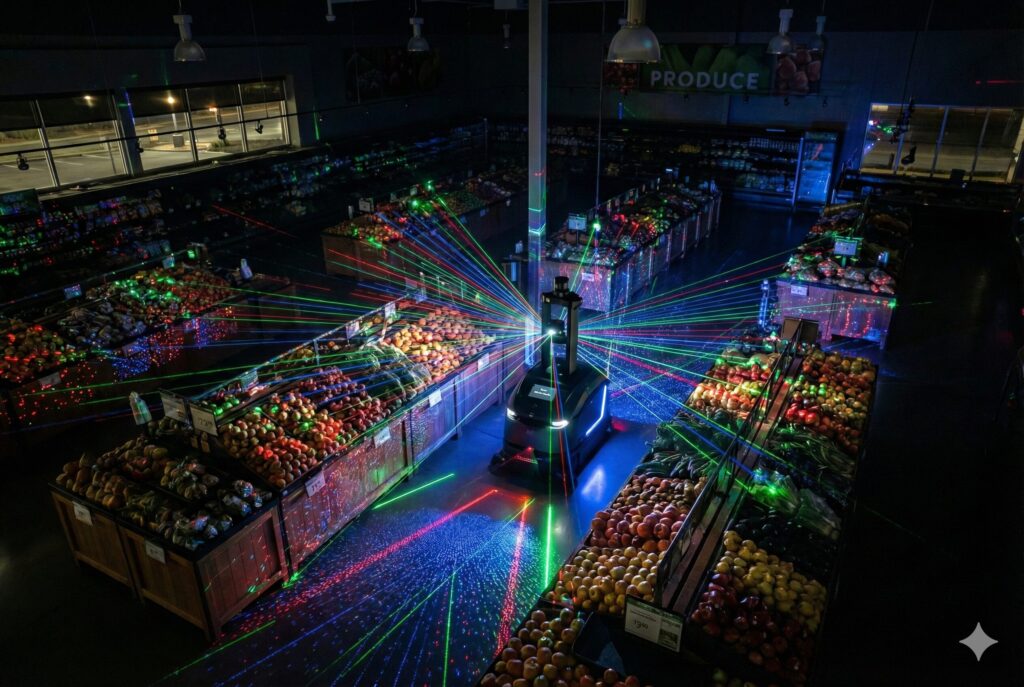
LiDAR is often considered the gold standard for industrial navigation. If you look at many autonomous floor scrubbers, you will see a spinning cylinder on top of the chassis. This is the LiDAR sensor.
- How it works: The sensor spins rapidly, emitting laser pulses that bounce off walls, racking, columns, and obstacles. It measures the “Time of Flight” (ToF)—the time it takes for the light to bounce back—to calculate distance.
- The Result: It creates a precise, 360-degree, 2D or 3D map of the environment in real-time.
- The Pros: LiDAR is incredibly accurate (often within centimeters). Crucially for 24/7 operations, LiDAR creates its own light, meaning these robots can operate in pitch-black warehouses during a graveyard shift without any issues.
- The Cons: It can sometimes struggle with highly reflective surfaces (mirrors or glass) or completely transparent obstacles, as the laser light may not bounce back as expected.
2. vSLAM (Visual Simultaneous Localization and Mapping)
vSLAM relies on optics rather than lasers. It mimics human sight.
- How it works: The robot uses stereo cameras to capture images of the environment at high frame rates. It identifies specific “visual landmarks”—a unique pattern on the ceiling, an Exit sign, the shape of a reception desk—and triangulates its position based on those features.
- The Pros: vSLAM provides rich contextual data. It can distinguish between a static wall and a dynamic object more easily in some contexts. It is also generally less expensive hardware than high-end industrial LiDAR.
- The Cons: Just like human eyes, cameras need light. A vSLAM robot may struggle in a dimly lit facility or a warehouse where the lights are cut to save energy at night. Furthermore, in environments that change constantly (like a cross-docking facility where walls of boxes appear and disappear), visual landmarks can become unreliable.
The Hybrid Approach:
Many top-tier manufacturers are now moving toward Sensor Fusion. They use LiDAR for the primary heavy lifting of mapping and obstacle detection, combined with cameras to identify “No-Go” zones signs or to detect glass walls. For the CFO, paying for sensor fusion is often an insurance policy against operational downtime.
The “Teach and Repeat” Mode: Bridging the Skills Gap
One of the biggest pushbacks Facility Managers face when introducing robotics is the workforce. There is a fear that operating these machines requires an engineering degree.
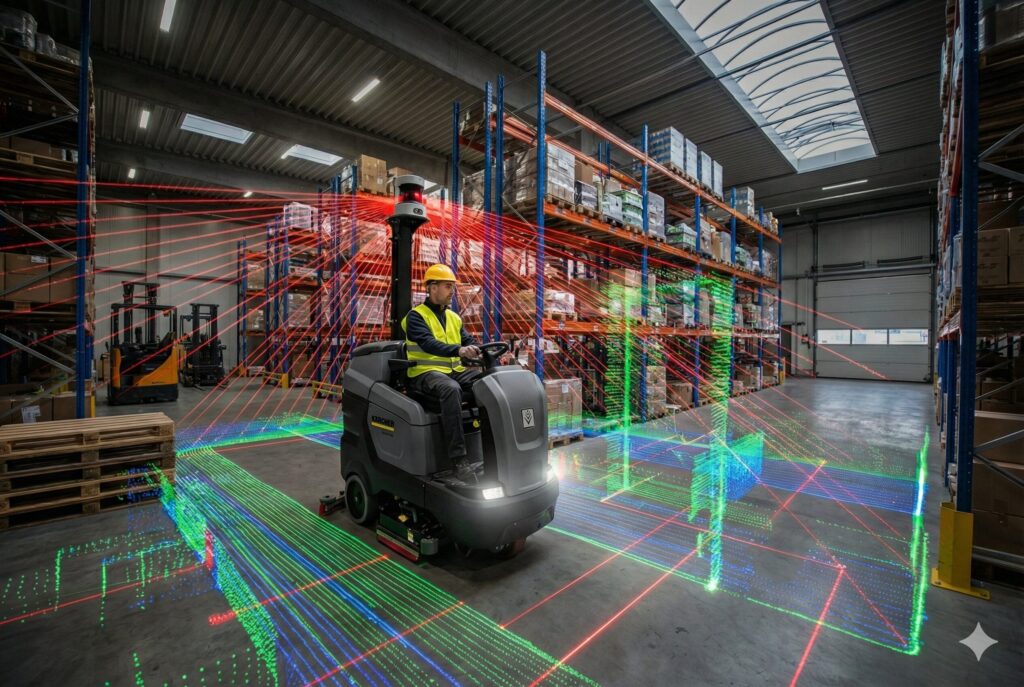
The reality is that manufacturers have designed these machines for the existing workforce. The User Experience (UX) is built around the “Teach and Repeat” principle.
The Setup Process:
- Manual Drive: The janitorial staff or facility lead physically stands on the machine (or drives it via a controller) and runs a cleaning route manually.
- Data Capture: As the machine is driven, it is recording everything. It maps the walls, records the water flow rate, the brush pressure, the speed, and the specific turn radius used at the end of the aisle.
- The Save: Once the route is finished, the operator saves it as “Zone A – Cafeteria” or “Zone B – Warehouse Aisle 4.”
The Daily Operation:
The next day, the operator simply wheels the robot to the starting point, selects “Zone A” on a touchscreen, and presses “Go.”
The robot compares what it currently sees (via LiDAR or vSLAM) with the map it saved during the training run. It then repeats the route perfectly. It creates a level of consistency that is impossible with human labor; the robot will never skip a corner because it wants to finish a shift early, and it will never drive too fast, compromising the cleaning quality.
Furthermore, these robots are equipped with dynamic replanning. If a pallet has been left in the middle of a cleaning aisle, the robot detects the blockage. Depending on its programming, it will either safely navigate around the pallet to clean the rest of the aisle or alert the facility manager via text that an area could not be cleaned due to an obstruction.
Are They Safe? The Liability Question
For the CFO and the Risk Management department, safety is the primary hurdle. A 1,000-pound machine moving autonomously through a hospital corridor or a busy retail store presents a theoretical liability.
However, statistics and engineering show that AMRs are often safer than manual operation. Human operators can be distracted, fatigued, or reckless. AMRs are governed by strict logic and unblinking sensors.
The Standards:
Modern commercial robots are built to rigorous safety standards, most notably ANSI/RIA R15.08. This is the standard specifically for industrial mobile robots, defining how they must behave near humans.
The Safety Bubble:
To comply with these standards, robots utilize a multi-layered safety system that operates much like a force field:
- Long-Range Detection: The LiDAR or main cameras look 20 to 40 meters ahead to path-plan.
- Slow-Down Zones: If a person or forklift enters a specific radius (e.g., 5 meters), the robot automatically decelerates to a “creep” speed.
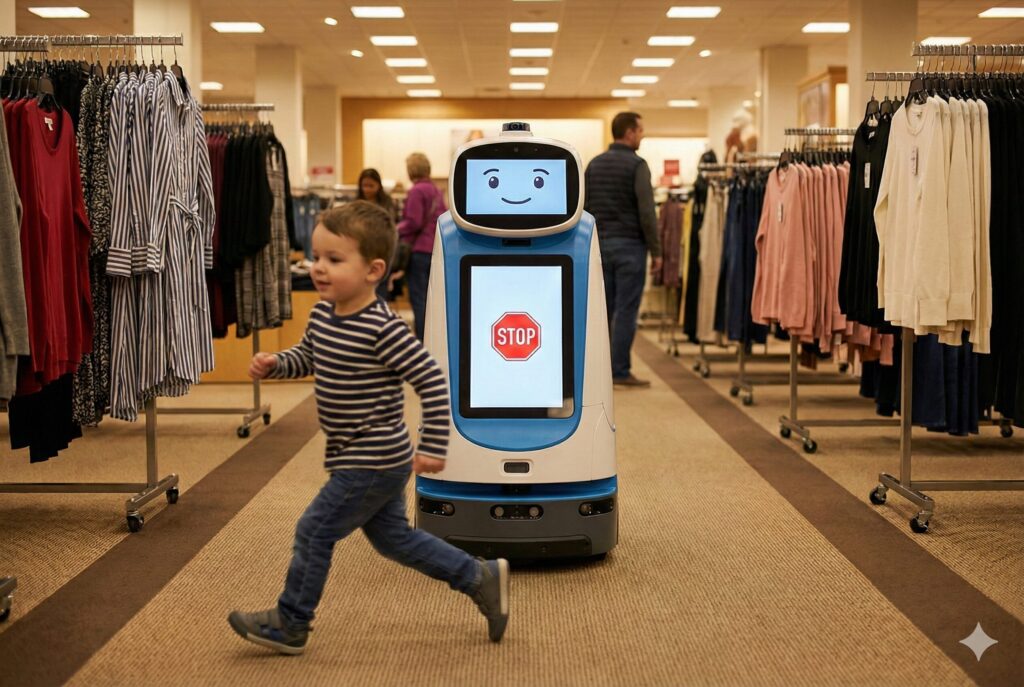
- The E-Stop Zone: Robots are equipped with ultrasonic sensors (similar to the backup sensors in your car) and 3D depth cameras specifically angled at the floor. If anything—a foot, a dropped box, a child—enters the immediate path, the robot executes a hardware-level emergency stop instantly.
- Drop-Off Sensors: Downward-facing sensors detect “cliffs,” ensuring the robot never tumbles down a flight of stairs or off a loading dock.
The Reality of Interaction:
In practice, these robots are timid. They are programmed to yield. If a robot and a human are on a collision course, the robot will stop, wait for the human to pass, or signal its intention to turn. They are designed to be “good citizens” of the facility.
The Bottom Line: Data, Consistency, and Efficiency
For the CFO, the “How it Works” is interesting, but the “What it Returns” is vital.
By understanding the technology—LiDAR precision, Teach and Repeat simplicity, and ANSI safety compliance—you can see that AMRs are not experimental technology. They are mature industrial assets.
They allow Facility Managers to reallocate labor. The human cleaner shifts from pushing a scrubber for four hours (a high-fatigue, low-satisfaction task) to focusing on high-value tasks like detail work, disinfecting touchpoints, or restroom sanitation, while managing the robot as a tool.
The robot provides the CFO with something manual labor cannot: Proof of Clean. At the end of every shift, these robots upload a heat map showing exactly where they cleaned, how much water was used, and where obstacles prevented cleaning. It turns facility management from a guessing game into a data-driven science.
New to Automation?
This article is Part 1 of our Start Here series.
Read Part 2: Are You Robot Ready? →