
Robot Vacuums, Scrubbers, and Sweepers – How to Choose
Introduction: There Is No “One Robot to Rule Them All”
In the consumer world, we are used to multi-purpose gadgets. Your phone is also your camera and your wallet. Your kitchen mixer can be a pasta maker. It is tempting to apply this same logic to industrial automation: the desire for a single “super-bot” that can handle every square inch of your facility.
In the commercial cleaning sector, however, specialization is not just a preference; it is a mechanical necessity.
A machine designed to extract fine dust from deep-pile hotel carpet will be physically destroyed if you attempt to use it to scrub hydraulic grease off a warehouse floor. Conversely, an industrial scrubber will flood a carpeted office corridor in seconds.
For the Facility Manager (FM) or Procurement Officer, selecting the right robotic hardware is the most critical decision after the initial site assessment. The market is flooded with different form factors, brush types, and sensor arrays.
To make an informed ROI calculation, you must understand the three primary hardware categories for autonomous robotic floor cleaners: Vacuums, Scrubbers, and Sweepers. Here is the definitive breakdown of what they do, where they thrive, and how to size them for your facility.
1. Commercial Robot Vacuums
The Specialists of Soft Surfaces
While these may look like overgrown versions of the disc roaming your living room, commercial autonomous vacuums are built for stamina and airflow. They are the workhorses of the hospitality and corporate real estate sectors.
- Best For: Hotels, casinos, corporate office corridors, convention centers, and airports with extensive carpeting.
- The Technology: Unlike scrubbers which rely on water weight and down-pressure, these robots rely on suction power (CFM – Cubic Feet per Minute) and brush agitation. They are typically engineered with a smaller footprint than industrial machines, allowing them to navigate the “tight squeezes”—between hotel room service trays, around office cubicle partitions, and under conference tables.
Key Metric to Watch: “Edge Cleaning”
The Achilles’ heel of early robot vacuums was the “dead zone”—the 2-inch strip of dust left along every wall because the robot couldn’t get close enough. Modern commercial units have solved this with side brushes that extend out from the chassis or offset brush decks. When evaluating a vacuum, ask for the edge cleaning spec. If the robot leaves 3 inches of dust along the baseboards, your staff still has to manually vacuum the perimeter, killing your labor savings.
Notable Examples:
- SoftBank Whiz: A ubiquitous sight in hotels, known for its simple “teach and repeat” interface.
- LionsBot R3 Vac: A newer entrant that focuses on sleek design and human-robot interaction for high-visibility public spaces.
2. Autonomous Scrubbers
The Heavy Hitters of Hygiene
If you manage a hospital, a mall, or a grocery store, this is likely the category you need. Scrubbers are the most common type of commercial robot because hard floor maintenance is the most labor-intensive task in facility management.
- Best For: Hard surfaces such as VCT (vinyl), terrazzo, polished concrete, and tile.
- The Technology: These machines perform three actions simultaneously:
- Solution Dispensing: They lay down a mixture of water and chemical detergent.
- Agitation: They scrub the floor with significant down-pressure (often 50-100 lbs) to loosen grime.
- Recovery: A rear squeegee and vacuum motor suck the dirty water back into a recovery tank, leaving the floor dry and safe for traffic immediately.
The Crucial Decision: Disc vs. Cylindrical
Within the scrubber category, you must choose a brush head type. This is often where buyers make mistakes.
- Disc Decks (Round Pads):
- Best for: Flat, shiny, smooth floors (think Target or a hospital corridor).
- Pros: They provide higher down-pressure for removing scuff marks and stains. They are cheaper to maintain (pads are inexpensive).
- Cons: They cannot handle debris. If a disc scrubber runs over a screw or a wood chip, it will streak and potentially damage the floor.
- Cylindrical Decks (Rolling Brushes):
- Best for: Industrial floors, grouted tile, or environments with light debris (warehouses, manufacturing).
- Pros: They sweep and scrub simultaneously. The rolling brushes fling small debris (pallet chips, gravel) into a catch tray while scrubbing.
- Cons: Slightly less effective at removing deep scuff marks on ultra-smooth floors.
Notable Examples:
- Tennant T380AMR: A compact powerhouse ideal for retail aisles.
- Avidbots Neo: A larger unit often seen in airports and malls, known for its advanced dynamic planning.
- Nilfisk SC50: A versatile mid-sized unit popular in Europe and North America.
3. Industrial Sweepers
The Debris Eaters
These are the tanks of the cleaning world. While a vacuum handles dust and a scrubber handles grime, a sweeper handles trash.

- Best For: Manufacturing plants, parking garages, construction sites, and lumber yards.
- The Technology: These are dry cleaning machines. They do not use water (usually). They use large, stiff bristles to throw heavy debris—wood chips, metal shavings, soda cans, gravel, and leaves—into a large hopper.
Why You Can’t Just Use a Vacuum:
If you run a robot vacuum over a metal shaving or a wet soda can, you will destroy the vacuum motor. If you run a scrubber over a pile of sawdust, you will create a sludge that clogs the squeegee. Industrial sweepers are the necessary “pre-clean” step for heavy industrial environments.

Notable Example:
- Gausium Scrubber 75 (Sweeper Config): Some machines are hybrids, but dedicated industrial sweepers are often purpose-built heavy equipment.
4. The Hybrid “All-in-One” Machines
The Versatile Problem Solvers
For many Facility Managers, the reality isn’t “carpet OR hard floor”—it’s both. You might have a tiled lobby that transitions into carpeted hallways, or a breakroom that needs sweeping in the morning and scrubbing in the afternoon.
Enter the Multi-Function Hybrid. These machines are rapidly gaining popularity because they solve the “Two-Robot Problem.” Instead of buying a vacuum for Zone A and a scrubber for Zone B, you deploy a single unit that can adapt to the environment.
- Best For: Mixed-use facilities (Universities, Corporate Campuses, Retail with carpeted sections), or dynamic environments where needs change by the hour.
- The Technology: These units often feature swappable “heads” or dual-mode functionality.
- Combo Sweep/Scrub: Some units, like the Gausium Scrubber 50, can sweep debris into a tray and scrub simultaneously, or switch modes entirely.
- Combo Vac/Scrub: Other units allow you to physically swap the brush deck from a vacuum head to a scrubber head in under 10 minutes.
The Strategic Advantage:
The primary benefit here is Asset Utilization. A dedicated scrubber might sit idle for 20 hours a day. A hybrid machine can scrub the cafeteria at 2:00 PM, and vacuum the conference rooms at 8:00 PM. This maximizes the return on your capital investment and reduces the total footprint needed for storage. While they may not have the massive tank size of a dedicated industrial rider, their flexibility makes them the “Swiss Army Knife” of the fleet—perfect for complex, modern buildings.
The Size Factor: Physics Cannot be Negotiated
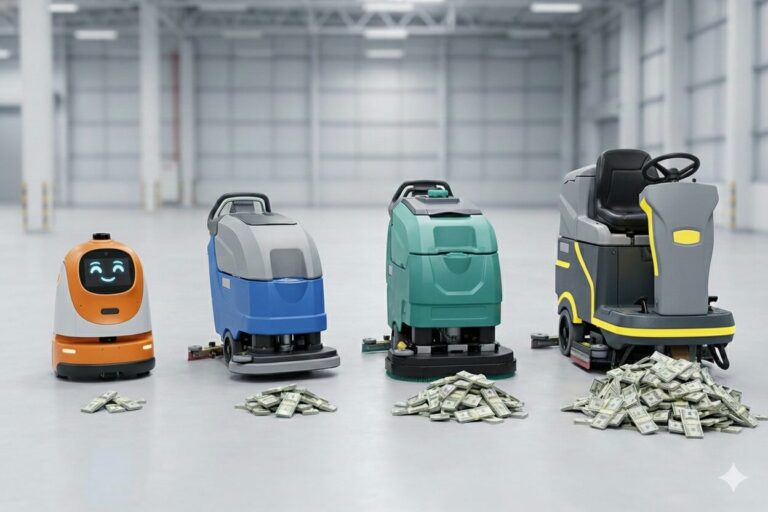
Once you have selected the type of robot (Vacuum, Scrubber, or Sweeper), you must select the size. In the industry, we categorize these by “cleaning path width” and tank capacity.
Choosing the wrong size is the primary cause of “Buyer’s Remorse.”
- Too Small: The robot runs out of battery or water before finishing the lobby.
- Too Big: The robot physically cannot fit down the aisles or turn around in the elevator.


Here is a general sizing guide for the Facility Manager:
1. Medium (The “Agile” Class)
- Cleaning Path: 18–24 inches
- Ideal Space: < 5,000 to 15,000 sq. ft.
- Use Case: Retail stores with narrow aisles, office breakrooms, classrooms, hotel corridors.
- Pros: Can make tight U-turns; fits through standard doorways easily.
- Cons: Small water tanks require frequent refilling (human intervention sometimes required).
2. Large (The “Corridor” Class)
- Cleaning Path: 26–32 inches
- Ideal Space: 20,000 – 50,000 sq. ft.
- Use Case: Large grocery stores, hospital main concourses, university student unions.
- Pros: Great balance of battery life and tank size. Can usually clean for 3-4 hours on a single charge.
3. X-Large (The “Open Space” Class)
- Cleaning Path: 34–45+ inches
- Ideal Space: > 50,000 sq. ft.
- Use Case: Airport terminals, convention centers, logistics warehouses.
- Pros: Massive tanks mean it can run for hours without needing a refill.
- Cons: Large turning radius; challenging in tight, crowded areas.
4. Industrial Rider / Outdoor (aka: Very Big)
- Cleaning Path: 50+ inches
- Use Case: Parking lots, city sidewalks, massive distribution centers.
- Note: These are often distinct from indoor AMRs and fall under different safety regulations.
Summary: Match the Machine to the Mission
There is no glory in buying a Ferrari to plow a field.
- If you have carpet, you need a Vacuum with good edge cleaning.
- If you have shiny warehouse floors, you need a Cylindrical Scrubber.
- If you have narrow retail aisles, do not buy an X-Large unit just because it cleans faster; buy a Medium unit that won’t get stuck.
The goal of automation is to reduce human intervention. If you buy the wrong machine, you will spend more time un-jamming it, refilling it, and apologizing for it than you would have spent just mopping the floor yourself.
Helping you find the right machine is the reason why we’re here.
Next Steps:
Not sure which machine fits your specific floor plan? Try our Find My Robot Tool. Answer a few questions about your facility size and floor type, and get a tailored recommendation in 30 seconds.
New to Automation?
This article is Part 3 of our Start Here series.
← Read Part 2: Are You Robot Ready? | Read Part 4: Costs→