The Real Cost of Robot Cleaners: 2026 Pricing, RaaS, and Hidden Fees
Introduction: The “Call for Quote” Frustration
If you have spent any time researching commercial robotics, you have likely encountered the most frustrating barrier in the B2B world: the dreaded “Call for Quote” button.
In the consumer world, you can go to Amazon and see that a Roomba costs $400. In the industrial world, pricing is often treated like a state secret, hidden behind gated forms and aggressive sales representatives. For a CFO trying to build a preliminary budget, or a Facility Manager trying to decide if automation is even feasible, this lack of transparency is a major roadblock.
At Commercial Robot Vacuums we believe in radical transparency. While it is true that final pricing depends on volume discounts, specific sensor configurations, and deployment complexity, the market has matured enough in late 2026 to provide realistic, actionable price ranges.
Whether you are looking to spend Capital Expenditure (CapEx) to own an asset or Operational Expenditure (OpEx) to hire a service, here is what you can expect to pay for commercial autonomous mobile robots (AMRs).
1. The “Capital Purchase” Model (Buying It Outright)
The traditional method of procuring industrial equipment is the Capital Purchase. You pay a large upfront sum, and the machine becomes an asset on your balance sheet. You own it, you depreciate it, and eventually, you retire it.
The Financial Profile:
- Type: CapEx (Capital Expenditure)
- Pros: No ongoing monthly rental fees; you own the asset; potential tax advantages (depreciation).
- Cons: High upfront cash outlay; you bear the risk of obsolescence; you are responsible for out-of-warranty repairs.
The Market Pricing Tiers (2025 Estimates):
Prices generally correlate with the size of the “cleaning path” (width) and the complexity of the sensor stack.
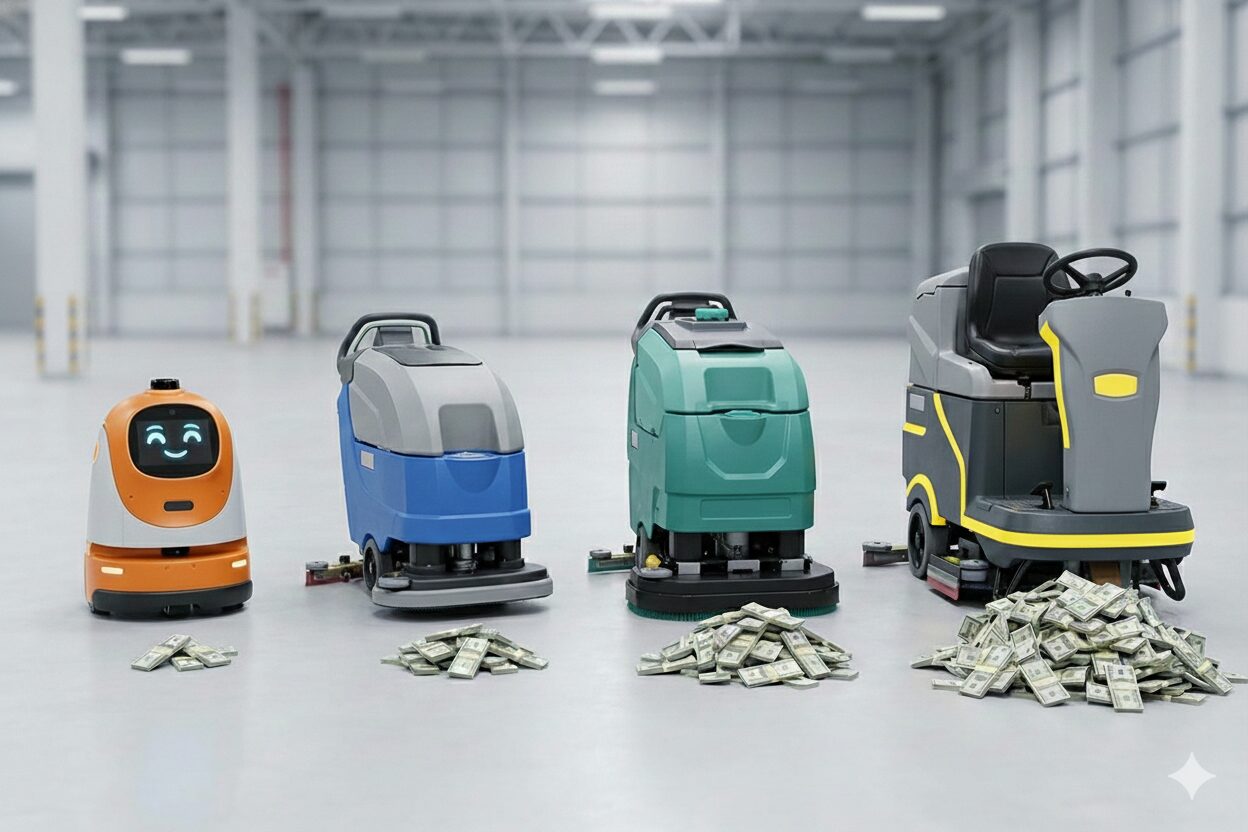
A. Medium Robots (Vacuums & Small Scrubbers)
These are the agile units designed for hallways, lobbies, and tight retail aisles.
- Price Range: $15,000 – $25,000 per unit.
- Typical Specs: 18–20 inch cleaning path, 2–4 hour runtime.
- Popular Examples:
- SoftBank Whiz: A vacuum-only unit, often found on the lower end of this spectrum.
- Pudu CC1: A versatile 4-in-1 unit (sweep, scrub, vacuum, mop) often priced around $22k depending on dealer support.
B. Large Robots (Mid-Size Scrubbers)
These are the workhorses for supermarkets, hospitals, and schools. They are substantial machines that require a “parking spot” rather than a closet.
- Price Range: $30,000 – $55,000 per unit.
- Typical Specs: 20–26 inch cleaning path, larger water tanks (15+ gallons).
- Popular Examples:
- Tennant T380AMR: A staple in retail environments.
- Gausium Scrubber 50: Known for its advanced station-docking capabilities.
C. X-Large Robots (Industrial Riders)
These are the heavyweights for airports, convention centers, and massive logistics hubs. They often look like traditional ride-on scrubbers but with a sensor tower added.
- Price Range: $60,000 – $85,000+ per unit.
- Typical Specs: 30+ inch cleaning path, massive battery life, and industrial durability.
- Popular Examples:
- Avidbots Neo 2: The standard for many airports.
- Tennant T16 AMR: A heavy industrial scrubber.
2. The RaaS Model (Robots as a Service)
Over the last three years, the industry has shifted aggressively toward RaaS (Robots as a Service).
Think of this as the “Netflix” or “SaaS” model for hardware. Instead of buying the robot, you pay a monthly subscription fee. This fee typically unlocks the hardware, the software license (cloud reporting), and arguably most importantly, the maintenance and support.
The Financial Profile:
- Type: OpEx (Operational Expenditure)
- Pros: Low upfront cost; predictable monthly billing; easier to approve in budgets (often falls under “Cleaning Supplies” or “Contract Services” rather than Capital Requests).
- The “Risk Shift”: If the robot breaks or the technology becomes obsolete in 3 years, it is the vendor’s problem, not yours.
The Market Pricing Tiers:
- Estimated Monthly Cost: $450 – $1,200 per robot, per month.
Why the Wide Range?
- $450/month: usually gets you a smaller vacuum unit (like a Whiz) on a longer contract term (36 months).
- $1,200/month: gets you a large industrial scrubber with a full “white glove” service package where the vendor handles all repairs and consumables.
The “Employee” Comparison:
For a CFO, the RaaS model makes the ROI calculation incredibly simple.
- Cost of a human cleaner (salary, burden, insurance): ~$3,500 – $4,500 / month.
- Cost of a robot (RaaS): ~$600 – $900 / month.
Even if the robot only does 50% of the tasks a human does (floors only), the math is overwhelmingly positive. You are essentially “hiring” a staff member for $4/hour.
3. The “Hidden” Costs to Watch For
Whether you choose CapEx (Purchase) or OpEx (RaaS), you must budget for the Total Cost of Ownership (TCO). A robot is a mechanical device with moving parts that rub against abrasive floors. Things will wear out.
If these aren’t in your budget, you will have a surprise conversation with your finance department in six months.
A. Consumables (The “Tires and Oil”)
Just like a manual scrubber, robots need regular replacements of wear items.
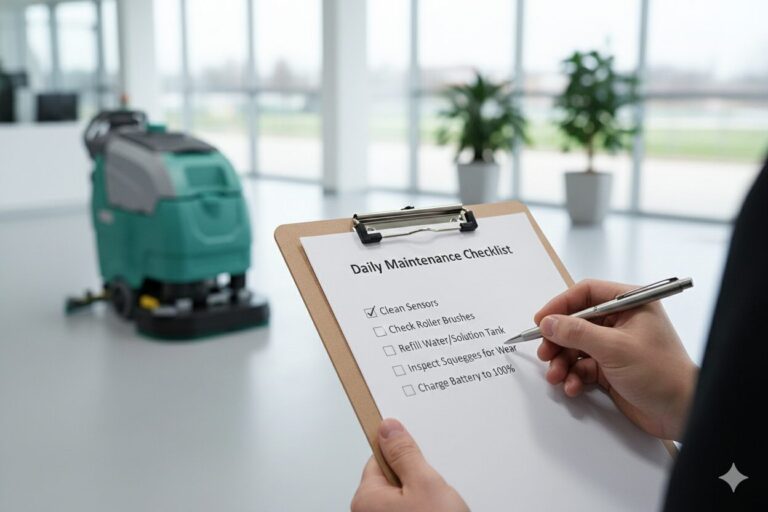
- Squeegee Blades: These rubber strips scrape the water off the floor. They wear down and need replacing every 2–4 months.
- Brushes/Pads: The scrubbing deck pads wear out based on floor roughness.
- Filters: HEPA filters in vacuums need changing to maintain air quality standards.
- Budget Impact: $500 – $1,000 per year, per robot.
B. Service Plans (The Insurance)
If you buy the robot outright (CapEx), DO NOT skip the service contract.
Robots are complex computers on wheels. If a LiDAR sensor fails or a wheel motor burns out, the repair bill can be thousands of dollars.
- Budget Impact: Typically 10% – 15% of the machine’s purchase price annually. (e.g., on a $40,000 machine, budget $4,000/year for the service contract).
- Note: In a RaaS model, this is often included in the monthly fee—always double-check your contract.
C. Batteries (The Fuel Tank)
Battery technology has improved, but it is not infinite.
- Lithium-Ion (Standard): Most modern AMRs use Li-Ion. They are maintenance-free and last 3–5 years.
- Lead-Acid / AGM (Budget): Some cheaper or older models use Lead-Acid batteries. These are heavy, require maintenance (watering), and often need replacing every 18–24 months.
- LFP (Lithium Iron Phosphate): Rapidly becoming the industry favorite. These are safer than standard Lithium-Ion (virtually zero fire risk) and offer a massive lifespan (2,000+ charge cycles). While slightly heavier, they will possibly outlast the robot itself, effectively eliminating replacement costs.
- Budget Impact: A full Lithium battery replacement can cost $2,000 – $5,000.
The Verdict: Which Model is Right for You?
Choose the “Capital Purchase” (Buying) if:
- You are cash-rich and want to minimize long-term recurring costs.
- You have an internal maintenance team capable of basic repairs.
- You plan to use the machine for 5+ years and want to depreciate the asset.
Choose “RaaS” (Leasing) if:
- You want to preserve cash flow.
- You want to “try” automation without marrying the technology.
- You want a fixed, predictable monthly cost with no surprise repair bills.
- You want the flexibility to upgrade to the “latest and greatest” model in 3 years.
Next Steps:
New to Automation?
This article is Part 4 of our Start Here series.
← Read Part 3: Selection | Read Part 5: Maintenance →